|
From 'R' Valve to Triode-Hexode. Valve development has made such great strides that it is only the old-timer who appreciates the vast difference between as present types and the old 'R' valves, which were probably the only specimens generally available when broadcasting began some fifteen years ago. In this article the history of the valve is traced through these years.
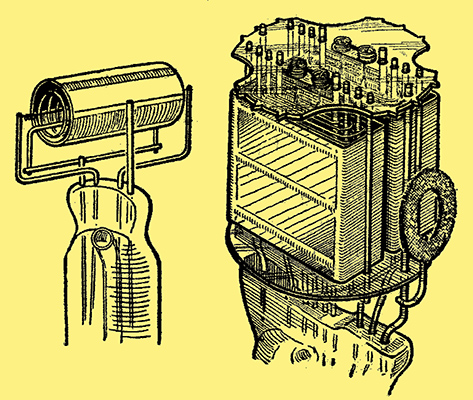
The electrode structure of an 'R' valve is shown on the left, and a modern multi-electrode type on the right.
When modem radio valves are compared with those used in the early days of broadcasting, either on the basis of their =quantitative or their technical efficiency, the enormous progress which has been achieved in fourteen years is at once apparent. It is, of course, a. commonplace to those who have been associated with the industry since its foundation, but there are very larger numbers of listeners whose experience dates from quite recent days, and so it is well, from time to time, to trace back the landmarks on the road of progress in order to appreciate what has been done.
Progress has been made along three principal lines sometimes in one direction, sometimes in others, and occasionally in all directions simultaneously. These three directions are in respect of:-
(a) | cathode efficiency and performance. |
|
(c) | consistency of performance. |
|
Each will be dealt with in turn.
With the exception of valves having an appreciable gas it content, which had a limited vogue as sensitive detectors, the only valves available to the pioneer listener were the 'hard' or highly evacuated triodes with tungsten filaments which were commonly known as the R Type. Judged by present-day standards, the emissivity of these filaments was extremely low - of the order of 200-300 mA/sq cm of cathode surface when operated at bright heat corresponding to a temperature of about 2,500 K, and their efficiency was equally poor, being from 3 to 4 mA/Watt of filament consumption only. A low tension consumption of some 3 Watts was therefore needed for each valve, to supply which large and, expensive 4 Volt accumulators were necessary, and the cost of recharging was a serious item. Moreover, the filaments themselves were subject to some disadvantages, namely, erratic life, distortion due to the high operating temperature, and so forth, and the high cost, originally 35 s each, was a considerable obstacle to the rapid development of the industry.
Exhausting by Getter
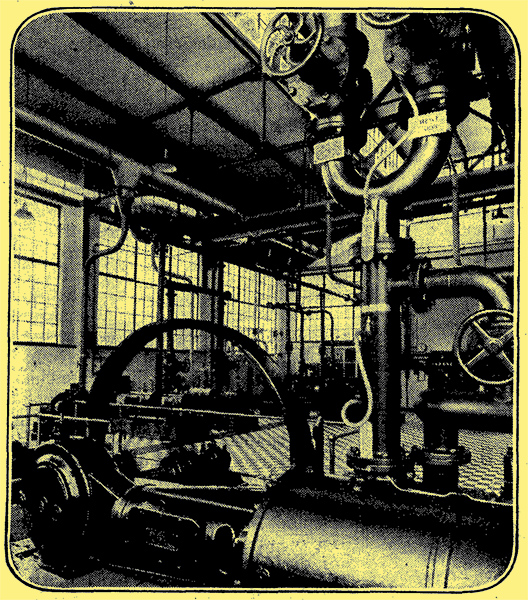
A view of a corner of the Mullard valve works.
In an attempt to improve filament life and filament efficiency, tungsten wires containing a proportion of thorium oxide were tried, such wires having already been adopted for electric lamps. Considerable success attended the experiment, and the emission of the new filaments was also found to be greater initially, although it rapidly fell off after a short period of service. The historic researches of Langmuir and others indicated that the rapid deterioration of the emissive properties was mainly due to the presence of residual gases in the bulb, a problem which was solved by improvements in methods of exhausting, culminating in the eddy-current method of heating the electrodes and of vaporising the magnesium getter
The emissivity of the thoriated tungsten filament was some 700 mA/sq cm an advance from 100 to 250% and the efficiency as much as 33 mA/Watt, so that considerable economies in low tension consumption resulted, and receivers could be operated with comparatively small and inexpensive accumulators. Although the filament temperature was reduced to between 1,800 and 1,900 K, they still had the disadvantages of the bright filament from the point of view of mechanical strength, especially as the lower wattage consumptions necessitated the use of small-diameter wires.
The next step in cathode efficiency was the result of experiments primarily directed toward improving characteristics and reliability, to be dealt with later, but in achieving these objects a much improved filament was also evolved. Previously, various workers, notably Wehnelt had noted the high emissivity of the so-called alkaline earth metals which include barium and strontium, and valves having platinum or other filaments coated with these oxides had been used by Round and others. Attempts were made to revive this type of filament improved form, but manufacturing difficulties, and the high cost of platinum, allied with its poor strength presented formidable obstacles for a long time. Ultimately the vapour process of producing oxide coated filaments swept most of these difficulties away, In this process an oxidised metal filament - usually tungsten - is after partial evacuation, exposed, to barium vapour, resulting in the formation of barium oxide on the surface of the cathode. The vapour may be derived directly from the metal or by the reduction of an unstable barium compound such as barium Azide by heating in vacuo. Filaments of this type operate at still lower temperatures, about 1,000 K, have a very satisfactory emissivity of the order of 500-600 mA/sq cm, and are three times as efficient as thoriated filaments, the figure being 100 mA/W.
Indirectly Heated Valves
More recently a return has been made in some types of valves to the pasted filament. The emissivity of pasted filaments is substantially the same as for those made by the vapour process, and the efficiency of the pasted nickel type is from 20 to 25% higher. The working temperature is about 850 K.
The revival of the Wehnelt cathode had another important result, namely, the development of the indirectly heated cathode for mains-operated valves. The types hitherto described employ filamentary cathodes, that is, the heated filament serves also as the valve cathode, and a potential gradient equal to the voltage of the low-tension battery exists along it. For use on AC low-tension supplies, an equipotential cathode was, however, essential except, perhaps, in the output stage, as otherwise the AC variations in the cathode potential modulated the anode current at supply frequency and resulted in intolerable hum.
The indirectly heated cathode consists, in essence, of a metallic tube, usually of nickel, with an oxide coating on its outside surface and an independent heating element inserted in the tube, adequate insulation between the heater and the cathode tube being provided by a hollow refractory cylinder interposed between the cathode and heater. Originally It developed for AC mains operation only, when the heaters were connected in parallel on a 4 Volt low tension supply, little difficulty was experience providing adequate electrical insulation between heater and cathode. The need for similar valves for use in DC mains receivers, and later for the so-called 'universal', i.e., AC/DC sets, in which it is necessary to operate the heaters in series on the mains voltage and thus permit considerable potential differences between heater and cathode in certain stages of the receiver, presented more formidable problems in the matter of insulation. Early solutions involved the use of insulators which materially increased the time taken by the cathode to attain emitting temperature, and recent developments have centred around reduction of heating time. Quick-heating cathodes are now fitted to AC mains valves, but valves in the universal range still take considerably longer to reach working temperature.
Valve Characteristics
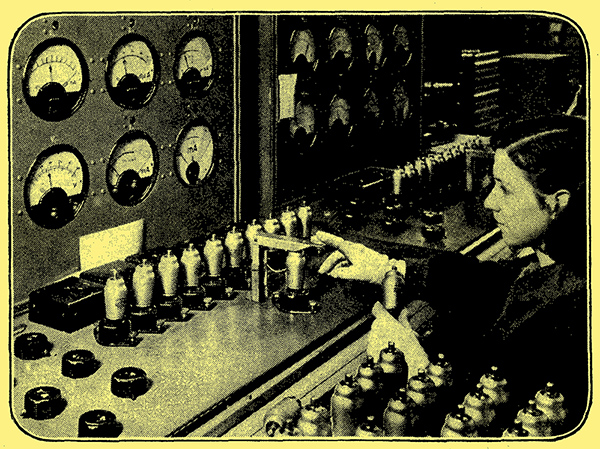
Valve-testing in the Mullard works.
Side by side with the evolution of the modem high-efficiency cathode the electrical characteristics of radio valves underwent steady improvement. It must be remembered that the only valve generally available for broadcast reception when the service was inaugurated was the hand made general purpose triode which had to serve as high frequency amplifier, as detector, as low-frequency amplifier, and, usually, as output valve also. Its characteristics were poor, a mutual conductance of considerably less than unity being the normal value. An impedance of the order of 30,000 Ω struck a not particularly happy medium for the many purposes for which the valve was employed, but it must be added that in those early days the connection between valve characteristics and circuit efficiency was not fully recognised. As knowledge grew, triodes of differing impedances were developed and labelled high frequency and low frequency types, and later special detectors and output valves having characteristics more particularly suited to the various functions appeared in makers lists. The pioneer work in this direction paved the way for the highly efficient triode output valves employed today for powerful domestic sets, public address equipment, and similar apparatus. But a still more important problem which had to be solved at that period was the provision of better valves for use as radio frequency amplifiers.
The comparatively high capacitances existing between the electrodes of the early triodes permitted serious feed-back of signal energy from the anode to the grid circuit, and resulted in instability which rendered efficient high frequency amplification impossible. The device of neutralising this feedback by an equal but opposite feed-back which could be adjusted by a variable, balancing capacitor resulted in some improvement in this direction, but was not completely effective over the whole tuning range of the receiver, and also added to the complexity of operation.
In 1927, however, the screened tetrode, popularly know as the 'screened grid' valve, was developed, and swept away the need of the neutralising circuit. In this valve a second grid, interposed between the control grid and anode, formed a fairly satisfactory electrostatic screen between the anode and grid circuits. Inter-electrode capacity was substantially reduced, and consistent and reasonably efficient high-frequency amplification was possible, the stage gain being greatly increased by the possibility of using coils of higher efficiency without risk of instability.
The Pentode
Meanwhile, the use of higher efficiency cathodes, improved constructions and more accurate manufacturing methods, had permitted, increases in the mutual conductances of valve types, usual values for general purpose triodes at this period being of the order of 2.0 to 3.0 mA/V. With the introduction of screened tetrodes, therefore, the valve situation was reasonably satisfactory with the exception of valves for the output stage, where the comparatively low sensitivity of the triode necessitated the use of muti-stage low-frequency amplifiers in sets of even moderate power.
The high gain obtained with the screened tetrode could not be utilised in valves suitable for operating as power output valves because, in order to obtain the necessary large output, the anode voltage swings would be so great that over a portion of each cycle the anode would beat a potential less than that of the screen, resulting in secondary emission from the anode and consequent unstable circuit conditions. But the solution was eventually found in the introduction of a third grid, the 'suppressor' grid between the screen and anode, connected back to the cathode, thus preventing the collection of secondary electrons by the screen or 'auxiliary grid' as it was then termed. The pentode valve thus came into being, and, due to its high sensitivity, effected as considerable reduction in the amount of low-frequency voltage amplification required, in many cases permitting a pentode to be driven directly from the detector stage.
The next important development in time sequence was the application of the pentode principle to high-frequency amplifiers so that, by avoiding the negative resistance effect the new valves, known as screened pentodes, gave stable operation over a wider range of anode voltage swing and required less critical adjustment of operating conditions. Full advantage could now be taken of tuned circuits of the highest efficiency, and stage gains of a much higher order were attainable.
Prior to the introduction of the screened pentode screened-grid valves with modified control grids came into use. These so called variable-μ valves were used with the already known variable grid bias method of adjusting the sensitivity of the receiver, either manually or automatically, to control the volume, and, in the case of the automatic volume control circuit, a substantially uniform volume level was maintained irrespective of carrier strength within certain limits. Automatic volume control also compensated, to a large degree, the effects of certain forms fading. The variable-μ type of grid was applied at also to the screened pentode and later to various forms of frequency changer.
The necessity, under conditions of increasing ether congestion, of improving the selectivity of household receivers, brought about a revival of interest in the superheterodyne type of receiver about five years ago. It had previously fallen out of favour on account of its tendency to re-radiate and difficulties in obtaining simple and efficient control of the circuit, using existing valves and components. Now, however, improved components and the wider choice of valve types made possible more satisfactory designs, the best, at the time, being the use of a screened-grid or screened pentode valve either as mixer valve in conjunction with a separate heterodyne oscillator, or as a complete frequency changer, the injection of the heterodyne frequency being effected in the cathode circuit. But the efficiency of this type of frequency changing device was low, and it was again left to the valve designer to solve the problem. The solution was the development of a new range of multi-electrode valves, each of which comprised a triode section for use as heterodyne oscillator and a mixer section of either screened tetrode or screened pentode characteristics, the two systems being arranged concentrically around a common cathode. The advantage of this arrangement is that the coupling between the oscillator and mixing systems is electronic; that is to say, the electron stream from the cathode is first modulated at heterodyne frequency and then remodulated at signal frequency, the intermediate or beat frequency being produced in the electron stream through the mixer section.
Modern Frequency Changers
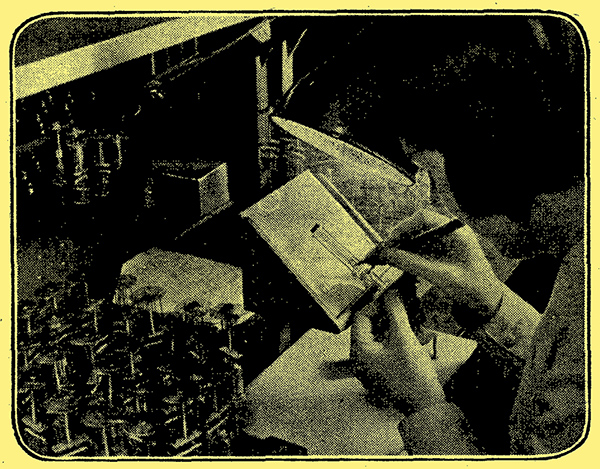
An operator examining the grid of a valve; one of the many routine checks on accuracy of construction.
The arrangement of the various electrodes in the octode is such that the cathode is surrounded by the oscillator grid and anode. Outside these electrodes come a screen-grid, the control grid, another screen-grid, a suppressor grid, and finally the anode. Only a portion of the total electron stream is collected by the oscillator anode, the remainder, under the influence of the high potential screen, forming a virtual cathode from which electrons are drawn by the mixer system.
Advantages of these frequency changers include negligible re-radiation, high efficiency as indicated by the value of the conversion conductance, and the ability to operate at low anode current values with corresponding reduction of valve noise level. The variable-muμ characteristics of these valves permits AVC to be applied to the frequency changer as well as to the radio frequency and intermediate frequency stages, thus increasing the effectiveness of the control.
At the same time, some circuit designers remained faithful to frequency changers of the type requiring circuit coupling between the oscillator and mixer sections, and more recently the growing desire to produce receivers for operation on short and ultra-short wavelengths has led to renewed interest in this type of valve, since valves of the electron-coupled type show a tendency to frequency drift at high and ultra-high frequencies, mainly due to space-charge effects which cannot satisfactorily be overcome by neutralising. Combined frequency changers comprising triode-oscillator and pentode-mixer in a common envelope, and requiring circuit coupling, had been available as an alternative to the electron coupled frequency changers of the heptode and octode types, but a more recent valve is the triode-hexode, comprising a triode-oscillator and hexode-mixer located on a common cathode, the heterodyne frequency being applied to the mixer system in this case after the electron stream in the hexode has been modulated at signal frequency. The characteristics of these valves are such that frequency drift is reduced to a very low value.
The general adoption of AVC and the growing desire for a higher standard of reproduction, together with the large gains obtainable in the pre-detector stages of modern sets, has, during the past two years, led to the general adoption of the diode as a detector, usually associated with a second diode in the same envelope for use as a rectifier for the AVC system. Previously, amplifying detectors of the triode or tetrode, or even screened pentode, types had been employed, but the necessity for amplification in this stage had disappeared, particularly since the use of reaction as a sensitivity and selectivity control was no longer essential. At first it was found desirable to employ a stage of audio frequency voltage amplification between the diode detector and the output stages, and this was sometimes achieved by employing a multi-function valve comprising two diodes and a triode in one envelope, and other combinations of diodes and amplifying systems also had a short vogue. High sensitivity output pentodes were then developed, which made it possible to drive the output stage direct from the diode detector, and the multi-purpose valve is now declining in popularity, although it survives in places as a combined duo-diode and high sensitivity output pentode.
Reliability
If there is one point more than another upon which valve manufacturers can justly congratulate themselves, it is that the enormous improvements in cathode efficiency and in operating characteristics already noted have not been achieved at any sacrifice of reliability. In fact, although the chemical reactions in cathode production are of the utmost delicacy and the constructions employed for the more elaborate types of valves are of high complexity, the consistency of performance shown by modern valves is far greater than that of any previous types.
It is true, that, from time to time during the development of new types, difficulties have arisen, but they have been speedily overcome and at the same time other problems, in connection with the consistent performance of valves under changing conditions of reception, have been completely solved. One such series of difficulties has been the matter of secondary emission. An apt parallel may be drawn between the emission of electrons from the heated cathode and the vaporisation of a liquid such as water. There are, in both cases, forces to be overcome before, in the one instance, the water molecules will leave the bulk of the liquid and enter the super-posed atmosphere as vapour or, in the other instance, electrons will leave the surface of the cathode. Again, the disposal of the water vapour under constant conditions of heating depends upon external forces, and in the same, way the voltages applied to the various electrodes of a valve determine the number of electrons which they will collect and the momentum with which those electrons will strike the surface of the collecting electrodes. Swiftly moving electrons will eject a certain number of secondary electrons, which give the effect of what may be termed a reverse conductance in the valve. In valves having pentode characteristics, the deleterious effects of secondary emission are avoided, so far as emission from the anode is concerned, by the suppressor grid, but with valves of high efficiency there may be a tendency to secondary emission from other electrodes, In eliminating this tendency many points have had to be taken into consideration, including materials used, form and construction, methods of manufacture, working conditions both electrical and thermal, and heat dissipation.
In order to trace how increased reliability and consistency of performance has been achieved it is necessary first to consider once again the valves available at the commencement of broadcasting. Valves of the R type were almost entirely hand made, and slight, or even considerable differences in dimensions and electrode spacing were unavoidable, resulting in corresponding variations in characteristics as between valve and valve of the same type. The gradual introduction, to an even increasing extent, of jigs and accurately adjusted automatic machinery, and extending knowledge and better control of the physical and chemical processes involved has in a large degree been responsible for improved uniformity of characteristics and performance.
Then improved processes themselves have contributed to this same end. For example, the modern pasted filament, by avoiding the deposition of excess barium on the bulb, has decreased unwanted capacity effects and, in the case of output valves, assisted in heat dissipation.
New cathodes and improved methods of manufacture at permitted closer electrode spacing, with corresponding increases in mutual conductance. But the introduction of powerful moving-coil speakers, often mounted in close proximity to highly sensitive valves, provided conditions of mechanical vibration under which even small movements of the electrodes produce rhythmic variations of characteristics resulting in over amplification of certain audio frequencies, a cumulative process which produced the noise known as microphony. More rigid constructions for the electrode systems were devised to solve the problem. Electrodes were made of stiffer section, and firmly anchored together mechanically, efforts in this direction culminating in the modern construction embodying 'steady' mica discs which, butting firmly against the inner flange of the domed bulb, lock the whole electrode structure securely and prevent even infinitesimal inter-electrode movement.
Above all, there has been the constant trend towards greater and greater accuracy in manufacture and assembly. Valve components, sub-assemblies and assemblies, manufactured to the closest limits and designed with a view to increased electrical insulation and minimum capacity, accurate control of each and every manufacturing process and, finally, the most rigid final testing, have combined to render the modern radio valve an instrument of precision, and to ensure a standard of reliability and consistent characteristics of the very highest order.
|