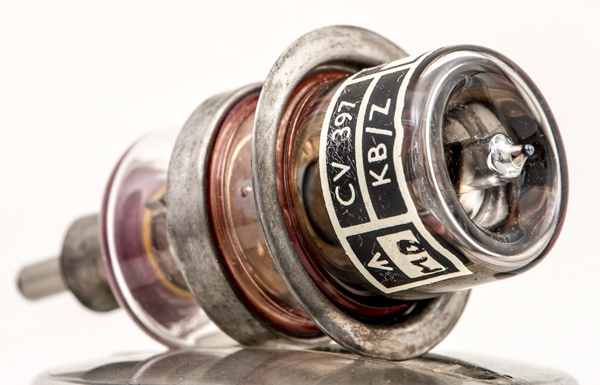
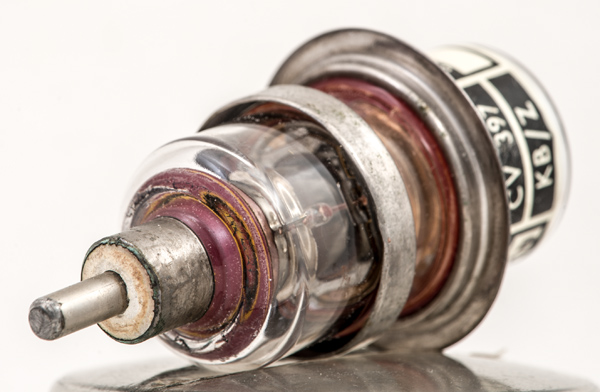
The CV397 is a disc seal triode based on the VX3058. In use the valve would be fixed into a pair of cavities. The grid is a fine mesh and the anode is in close proximity to the grid. The central base connection is one side of the heater and the surrounding tube connection is the other end of the heater and the oxide coated cathode.
The CV397 and its commercial equivalent the DET24 date from the latter part of WWII. It could produce up to 10 Watts of output at frequencies up to 2 GHz.
The KB/Z identifies this valve as being made to specification K1001 or K1006, the B denotes qualification by a UK authority and the Z identifies the maker as MO Valve Company, Hammersmith.
The re-entrant style of anode end. The evacuation tube sits in the centre.
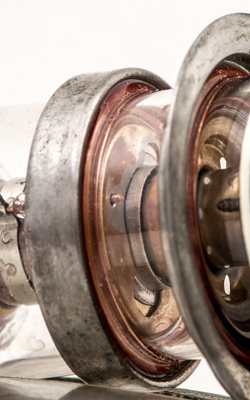
The composite components of the control grid. Near the bottom of the copper anode one can just glimpse the parallel grid wires. These would be under tension and form a frame grid to allow the minute inter-electrode spacing required for conventional microwave valves.
The valve would sit in a co-axial cavity with the heater, heater plus cathode ring followed by the grid ring and finally the anode ring.
The planar envelope is 20 mm in diameter, and is 65 mm tall.