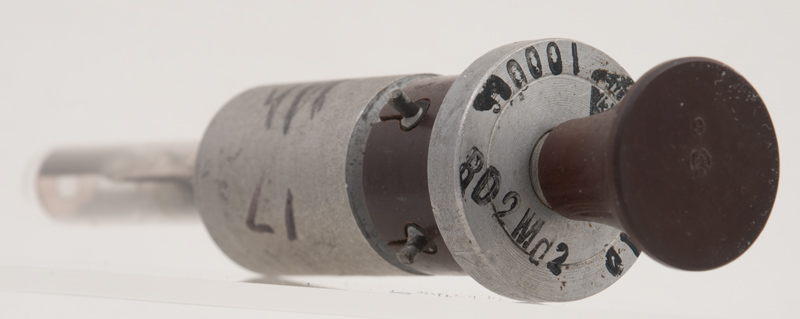
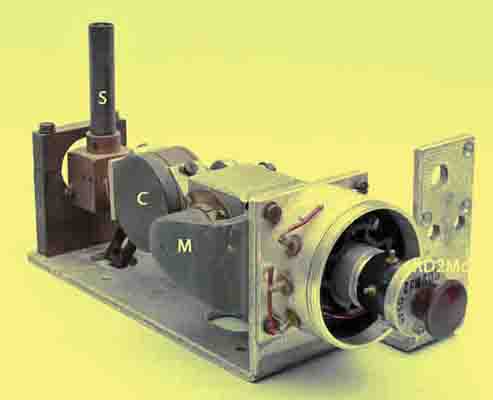
The RD2Md2 from Telefunken is a Wehrmacht era split anode magnetron introduced in 1944 and the output is 500 mW at 2.4 GHz (10 cm). The external magnetic field required to cause the electrons to spiral is 1,450 Gauss.At the top of the slender glass tube is a pair of Lecher lines that capacitively coupled to a pair of external lines.
The code on this exhibit is 0144 that equates to January 1944.
This tunable magnetron was used in several radar units including the Berlin.
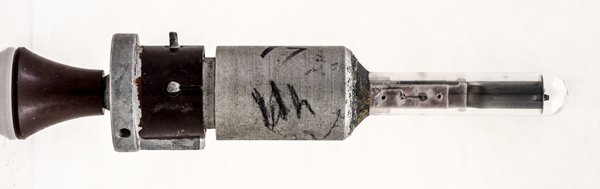
The keyway to guide the valve into the base is on the lower left. The German WWII valves were often mounted on the front panel for ease of servicing. The attached Bakelite handle allowed easy removal.
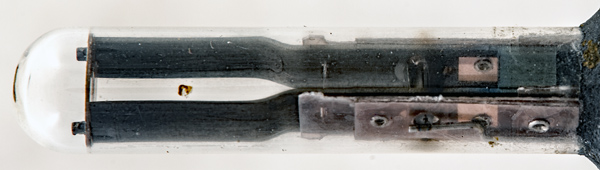
The Lecher lines at the top and the small magnetron proper is mounted horizontally. One side of the filament is clearly visible.
The output lines and the split anode.
A closer view.
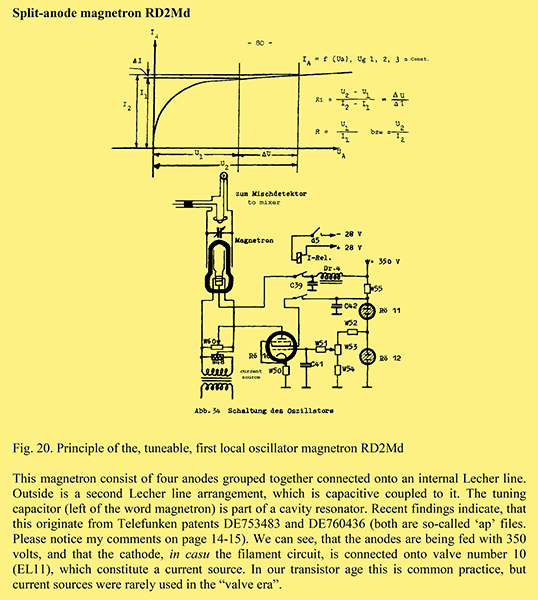
Principle of operation.
Local oscillator of Berlin FuG224 radar apparatus (1944/45), The split-anode magnetron being pulled out of its socket a bit. Just visible is that this tube was accepted by the German Armed Forces in week 1 of 1945 (= 0145). C = resonant tuned cavity; M is the permanent magnet, which field stands across the split-anode inner space, parallel with the filament; S is a matching stub.
The above image and text was located here and we gratefully acknowledge the source.
The thin glass tube envelope is 10 mm in diameter, and is 43 mm tall. From tip to base ignoring the handle is 99 mm and the metal body is 21 mm in diameter.
Reference: Internet. Type RD2Md2 was first introduced in 1944. See also1944 adverts.