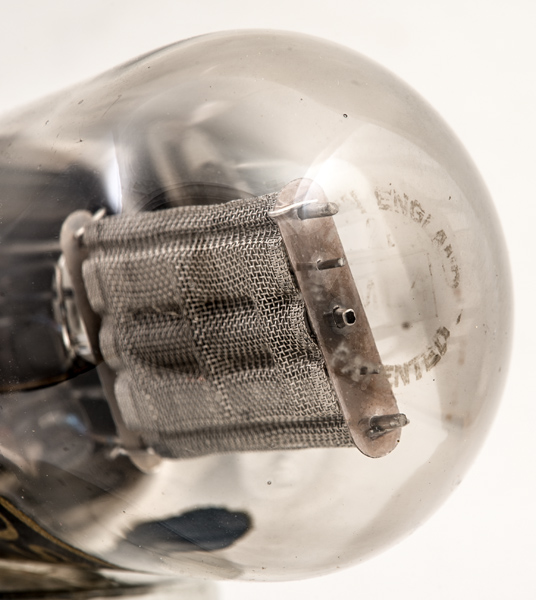
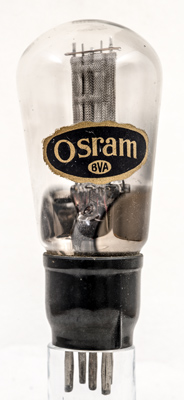
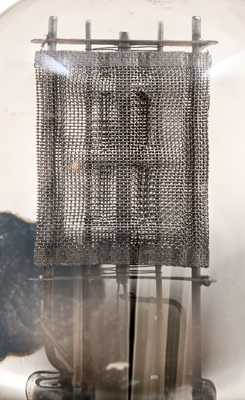
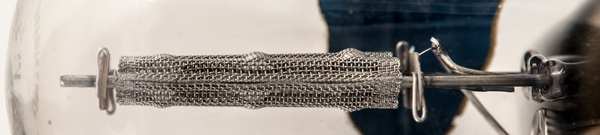
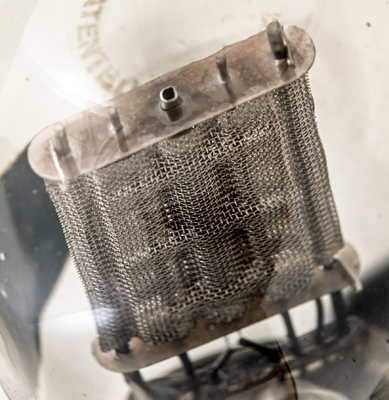
This ML4 looks to be an early example as it is enclosed in a balloon envelope and has a mesh anode. Later production used the shouldered or classic envelope shape where the reduced diameter was employed to hold the top mica firmly in place.
Although sometimes listed as a triode output valve, the ML4 was the definitive descendent of the famous (or infamous) Type KL1 of 1926 and was primarily a professional and military type, little used in domestic radios.
The ML4 was quite widely used as an RF oscillator, as a single-valve phase splitter, and as a driver for larger valves.
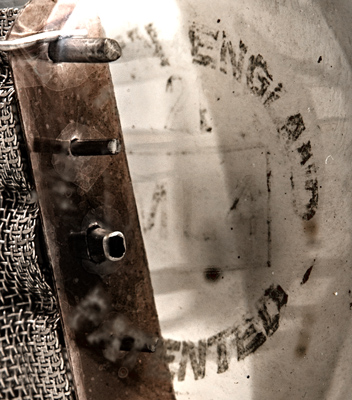
The ML4 heat set printed on the dome.
The Osram brand label.
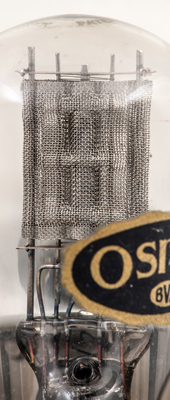
The mesh anode with control grid winding showing above.
Below the mesh anode the shape of the grid wires can be seen. These are close together near the supports and open out to an oval shape around the cathode.
A closer view.
Side view.
The mesh anode has ridges pressed into it to add mechanical stability.
The balloon envelope is 50 mm in diameter and, excluding the B5 base pins, is 111 mm tall.
References: Data-sheet, 1040 & 1043. Type ML4 was first introduced in 1929. See also1929 adverts.