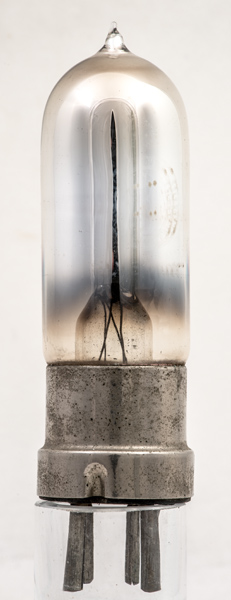
The AR is a bright emitter receiving triode. The AR stands for Amateur Radio. The AR design originated in 1922 and was a development of the R Type, the μ was given as 10. Ediswan were among the first manufacturers of the R Type in Britain and the AR shows the way that valve technology developed. The anode became a vertical cylinder and the filament became supported on a sprung support to maintain filament tension when hot. The move to a vertical anode is interesting as the original TM valve used a horizontal anode to remove the original problems of the vertical anode.
Another AR in the museum has a red vertical stripe denoting that the valve was suitable for HF use. This is similar to the red top of the Cossor P2 that also indicates that on test it was suitable for HF use.The envelope is silvered internally, this being the product of barium and magnesium gettering, and the inner details are not visible. However, when phosphorus getting was used (seeAR) the result was a transparent orange coating that allows the structure to be seen.
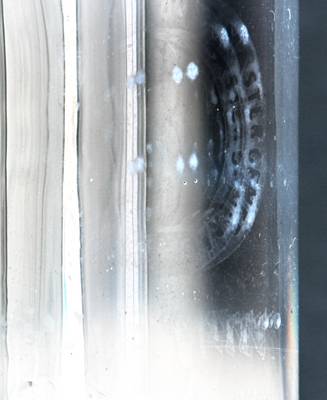
This image has been enhanced to shoe the lettering of the BBC stamp. The words'Postmaster General' indicate the type one stamp that was used form November 1922 to September 1924 and thus fixing the date of manufacture for this exhibit. At the lower right of the picture is the N of Ediswan.
This enhanced image shows the Type designation as AR.
The wide glass tube envelope is 29 mm in diameter, and excluding the B4 base pins is 94 mm tall.
References: 1004 & 1003. Type AR was first introduced in 1922. See also1922 adverts.