|
The Murphy Radio Company, in the 1930s made its name (and its profits) by putting well engineered but somewhat basic superhets based on the AC/TP into rather nice wooden cabinets. The AC/TP was specifically designed to allow some degree of oscillator 'pulling' by strong signals. This arrangement allowed the less proficient users of the wireless to easily tune in their favourite local stations. It did, however, also mean that the discerning listener had less than perfect tuning for weak signals.
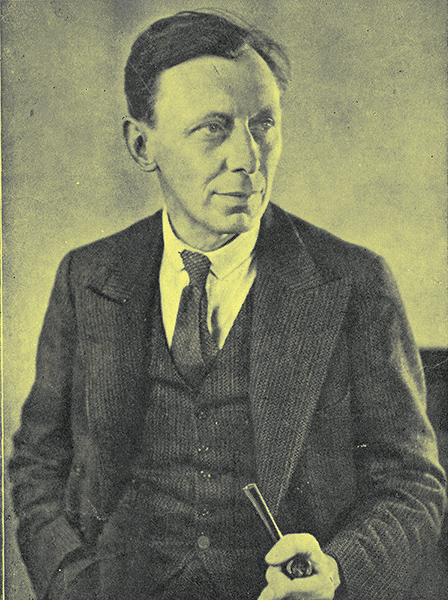
Frank Murphy BSc AMIEE AIRadE pictured in 1931
The AC/TP itself was not designed for frequencies above a few MHz so Murphy sets covering Short Waves used the AC/TH1 instead. Top-of-the-range sets used both types in a double-superhet arrangement with AFC and enabled the user to switch the AFC on or off at will. The instructions state that the set should be tuned with AFC off then, when the desired station has been selected and tuned in exactly using a 'magic eye', the AFC should be switched on in order to lock the set to the station.
The AFC stage, typically using an AC/SP1 as control valve, interacted with the AC/TP (which was designed to be pulled) in the second section of the double superhet.
The AC/VP1 and especially the AC/VP2 were widely used in Murphy radios in company with valves such as the AC/TP or AC/TH1, the AC/HLDD and the AC/2Pen. Interestingly, in such radios it is often the AC/VP1 (or AC/VP2) which wears out first, due to its 'vari-mu' characteristic which causes uneven stress on different parts of the cathode. These types are, therefore, in demand for maintaining old sets.
One of the first post WWII television receivers was the Murphy V114 from 1948. Images from the brochure are below and details are given of the valves and their function. .
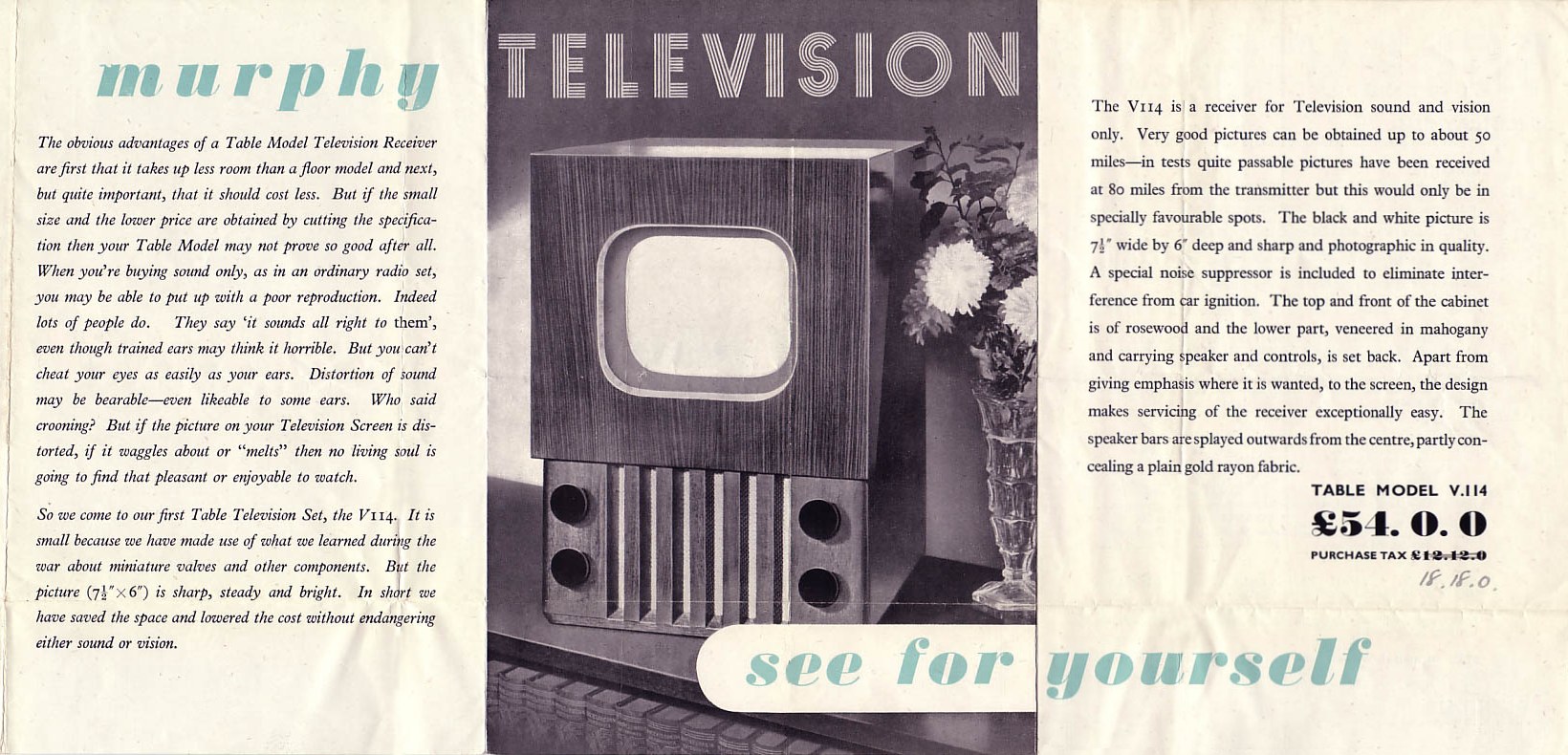
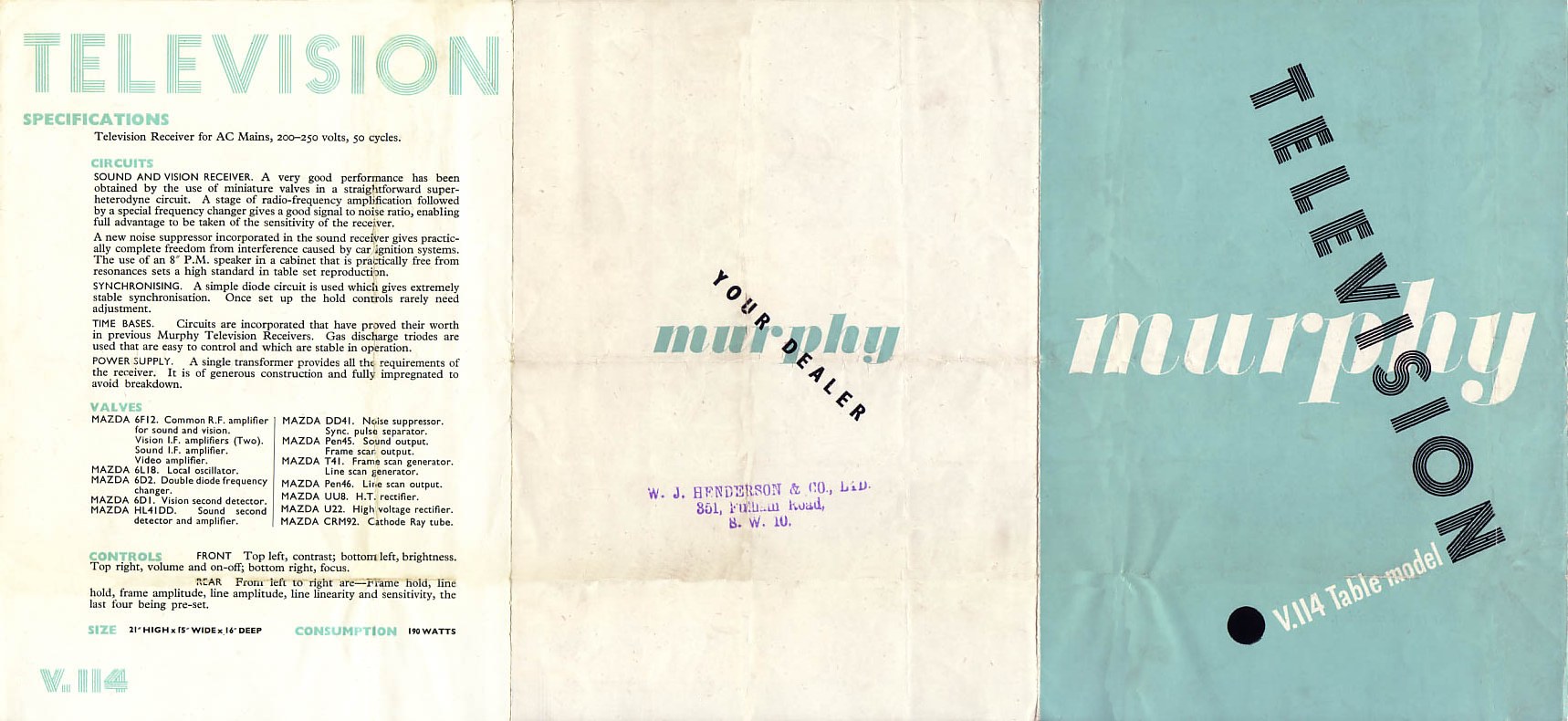
6F12 RF amp and both sound and vision IF amplifiers, 6L18 local oscillator, 6D2 double diode frequency changer, 6D1 vision second detector, HL41DD sound second detector and AF amplifier, DD41 noise suppressor and pulse separator, Pen45 audio output and frame output, T41 frame scan generator and line scan generator, Pen46 Line scan output, UU8 HT rectifier, U22 EHT rectifier and CRM92 CRT. .
|