|
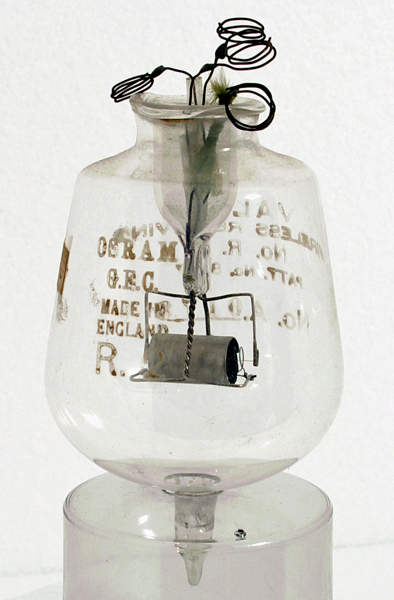
This Osram valve is marked 'Wireless Receiving' No. R2. The candelabra cap is missing.These are a rare and unusual specimens of British-made replacements for the de Forest audion. The BTH Audion was developed in 1916 and the design of the R2 came out of that work when BTH abandoned the Audion physical design in 1917 and based the new valve on the French TM or hard valve. The R2 was still a soft valve as the hard valves lacked the sensitivity required.The R2 sample appears never to have been used. In use the filament leads, here seen coiled up, were extended and connected to a candelabra (MES) screw stuck (with pitch?) over the pip at the top of the bulb, which then became the base! R5?. This is why the etched markings are apparently upside down with respect to the envelope.This Type R2 has nothing to do with the later rectifier.Audions, and the British-made replacements, were 'soft' (i.e. gas-filled) valves and had to be operated at low anode voltage (typically around 20V). In Britain such valves were used almost exclusively by the Navy, who went on doing so long after the other Services had moved on to using hard valves. It is interesting to note that even the earliest type (the R2) is clearly a derivative of the French TM valve which became the Type R design not made in Britain until 1916. Moreover, the Navy continued to develop and improve these soft valves. Later types, including the R2A and R2B, were externally similar to the R2 and R5 but had different gas fillings. The erratic characteristics of the soft valve paved the way for the universal adoption of the hard valve in spite of needing multiple stages to achieve the same gain.The triode construction is standard for the period, with a single filament strand passing through the centre of the anode cylinder, the grid is a wire helix surrounding the filament and supported both ends.See also the R.4.The balloon envelope is 52 mm in diameter and, excluding the base pins, is 92 mm tall.Reference: 1003. |
Updated September 28, 2016.
|
|