|
Valves and Tubes
The 19 and 23-inch television CRTs are now in almost universal use, but the new bonded-face tubes are only used by a few manufacturers. Brimar had, side-by-side and displaying identical pictures, the three versions of the bonded-face tube using glass, Diakon and matt glass face-plates. A simple and direct comparison with a hand- lamp quickly demonstrated the reflection-free properties of the last type. The diagram shows the simple mounting arrangement.
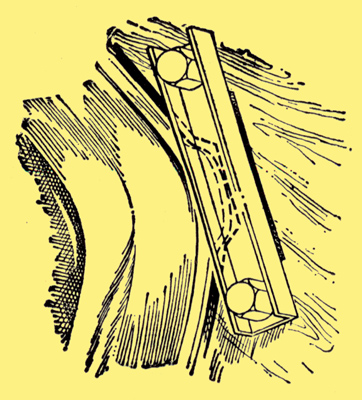
Simple mounting in cabinet is a feature of bonded-faceplate television Tube. (Brimar).
Useful for stereo tape-recorder level indication and for FM use is the double EMM802 (Brimar) "magic eye'. This has two independent sections governing the illumination of the fluorescent stripe on the bulb. The lighted areas "grow' from the ends of the bulb towards the middle as bias is applied to the control grids so that, by adding a rudimentary scale, two voltages can be compared. Another Brimar valve, the double triode 13D7, is designed for use in low-level low-noise preamplifiers. It has an amplification factor of 140 and can provide an average grid-hum level of only 3 μV-slightly more than low-noise AF pentodes - with a total valve gain of over 5,000.
From Mullard comes the PY33 mains rectifier valve for television, a valve which produces 10 V higher output than its predecessors running under the same conditions. The necessary close spacing of anode and cathode is made possible by a technique giving a very smooth, hard cathode surface: this involves the "pressing' of the emissive materials, instead of the usual spraying or dipping. Another valve from Mullard is a triode-heptode, type ECH84, which is particularly suitable for sync separation in negative-modulation TV receivers. Noise pulses often rise well above the sync-pulse level of the signal and, with a normal separator, give spurious sync outputs and block off the proper pulses. One way of avoiding this is to use a dual-control valve, such as a heptode, the noise pulses being separated and used to cut off the sync-separator electron stream, so preventing the third grid, to which video and sync signals are applied, from drawing current and thus blocking the following sync pulses.
Thorn-AEI, who last year as Ediswan-Mazda introduced the first variable-μ television frequency-changer (30C17) this year showed a range of new valves for television including a cascode double-triode giving the highest gain achieved so far from a single valve of this type (30Ll7). Slope is 15 mA/V, using frame-grid construction, and to overcome instability an arrangement which harks back to early days has been adopted. Two cathode connections are necessary, thus a ten-pin base would be necessary to allow earthing of the screening separately from the earthed grid. To avoid the introduction of a new base the screening is connected to one heater pin which must be isolated and bypassed to RF New video-amplifier valves (6F28 and 30FL12) allow for 405/625 working as an anode load as low as 4.7 kΩ can be used while not dropping the peak-to-peak VF output below 100 V at 190 V HT.
|