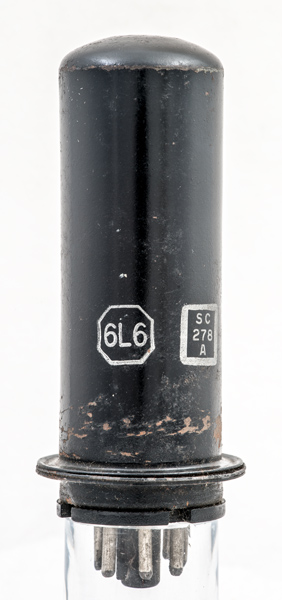
We believe RCA's metal 6L6 was the World's first true aligned-grid beam tetrode to reach Quantity Production status (around 1935).
A successful pre-production batch of the British (M-OV) type KT40 was produced at least a year earlier but its routine production was delayed and eventually abandoned because 'it was too difficult to assemble'.
Once RCA had showed that it could be done after all, M-OV copied the 6L6 with modifications thus producing the famous KT66.
The 6V6 receiver type of beam tetrode with which it shares pin connections is a derivative. This valve was mainly used for audio amplifiers.
The 807 was based on the RCA type 6L6 beam tetrode, which had a long, fairly thin, anode and a carefully-aligned grid structure. The 6L6 employed rapidly-accelerated electrons and short electron paths. This made it efficient but its characteristic had a distinct residual kink. It was a very successful valve but its characteristic was not quite straight enough to give the ultimate in audio quality at high output levels.
The KT66 was essentially a 6L6 redesigned with a larger cathode and a shorter, fatter anode. The KT66 had less rapid acceleration, longer electron paths, and almost no kink. It was ace for audio hi-fi.
A pair of 6L6's working in class AB2 push pull would deliver 47 Watts at 2% distortion. A lot of power in the 1940s and 1950s.
The metal tube hides the inner construction. Our all glass 6l6GT version has a description of the electrode construction.
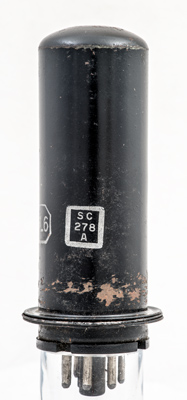
The makers code.
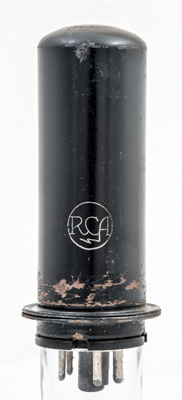
The RCA logo.
The wide metal tube envelope is 32 mm in diameter and excluding the IO base pins, is 92 mm tall.
References: Data-sheet and private correspondence. Type 6L6 was first introduced in 1936. See also1936 adverts.